China Supermarket 2025: Walmart, Sam's Club, Hema, and Yonghui — Four Paths
China’s brick-and-mortar supermarket sector split visibly in 2025. Traditional hypermarkets kept shrinking. Warehouse-club (membership) stores ran hard. The country’s signature “new retail” experiment finally broke even. The leading domestic chain was bought out after billions in losses and is now trying to reinvent itself as a “Pang Donglai apprentice.” These four threads, read together, make 2025 the most informative year for China retail in a decade.
This post takes four comparison-worthy players:
- Walmart China — foreign hypermarket chain undergoing structural transformation
- Sam’s Club — Walmart’s paid-membership warehouse club, the fastest-growing single supermarket format in China
- Hema (Freshippo) — Alibaba’s “new retail” survivor, first full-year profit in fiscal 2025
- Yonghui — Chinese domestic supermarket leader, acquired by Miniso for 6.27 billion RMB (29.4% stake) in late 2024 and now undergoing a full “Pang Donglai model” renovation
Different ownership, different formats, different paths. Looking at them side by side is the clearest way to see what the China supermarket market is competing on — and what it’s eliminating — today. Data comes from listed-company reports, official disclosures, leading financial media, and third-party research.
I. The Summary Table
| Dimension | Walmart China (hypermarkets + Sam’s + neighborhood) | Sam’s Club (standalone) | Hema | Yonghui |
|---|---|---|---|---|
| Ownership | Foreign (Walmart Inc) | Foreign (Walmart Inc) | Alibaba-owned (IPO postponed) | A-share listed, Miniso now largest shareholder |
| Formats | Hypermarket + Sam’s + neighborhood + cloud warehouse | Paid warehouse club | Hema Fresh (large stores) + outlet + NB discount + forward warehouse | Traditional supermarket + Pang Donglai-model renovation stores |
| 2024-25 sales | FY25 ~147.3 billion RMB; FY26 accelerating (Q3 revenue $6.1B, +21.8%) | 2025 broke 140 billion RMB (+~40%) | FY25 GMV ~75 billion RMB | FY24 revenue 67.57 billion RMB (-14.07%) |
| Profitability | Overall profitable (Sam’s driven) | Strongly profitable (dual revenue: goods + membership) | FY25 first year of positive adjusted EBITA | FY24 net loss 1.465 billion RMB (cumulative 4-year loss ~9.5 billion) |
| Store count (end of 2025) | Walmart hypermarkets ~283; Sam’s 61-63; neighborhood stores expanding | 61-63 (10 new stores in 2025, a company record) | Hema Fresh 420+, Hehesuan NB 400-500 | Peaked ~1,000; 2025 renovated 315 + closed 381, now ~800+ |
| Per-store annual sales (2024) | — | Above 2.2 billion RMB; top 8 stores above 3.6 billion | ~196 million RMB | ~85 million RMB (far below peers) |
| Private label share | Gradually rising | ~30%+ (Costco’s Kirkland is the international benchmark) | Hema Fresh ~50%, NB 60%+ | Renovated stores scaling fast |
| Membership | Non-membership (except Sam’s) | 10.7 million paid members; 260 RMB / 680 RMB tiers; ~2.2 billion RMB in fees | Old X Club closed | Non-membership |
| E-commerce share | 50%+ (globally leading) | High (app-booking + cloud warehouse delivery) | Native online + store-warehouse integration | Low |
Sources: Walmart FY26 Q3 earnings, Walmart China corporate site, Sam’s Club China official disclosures, Alibaba quarterly calls, Yonghui A-share (601933) filings and reports, and reporting from China Daily, Sina Finance, STCN, CBNData, and Momentum Works.
II. Walmart China: Hypermarkets Shrink, Sam’s Takes Over
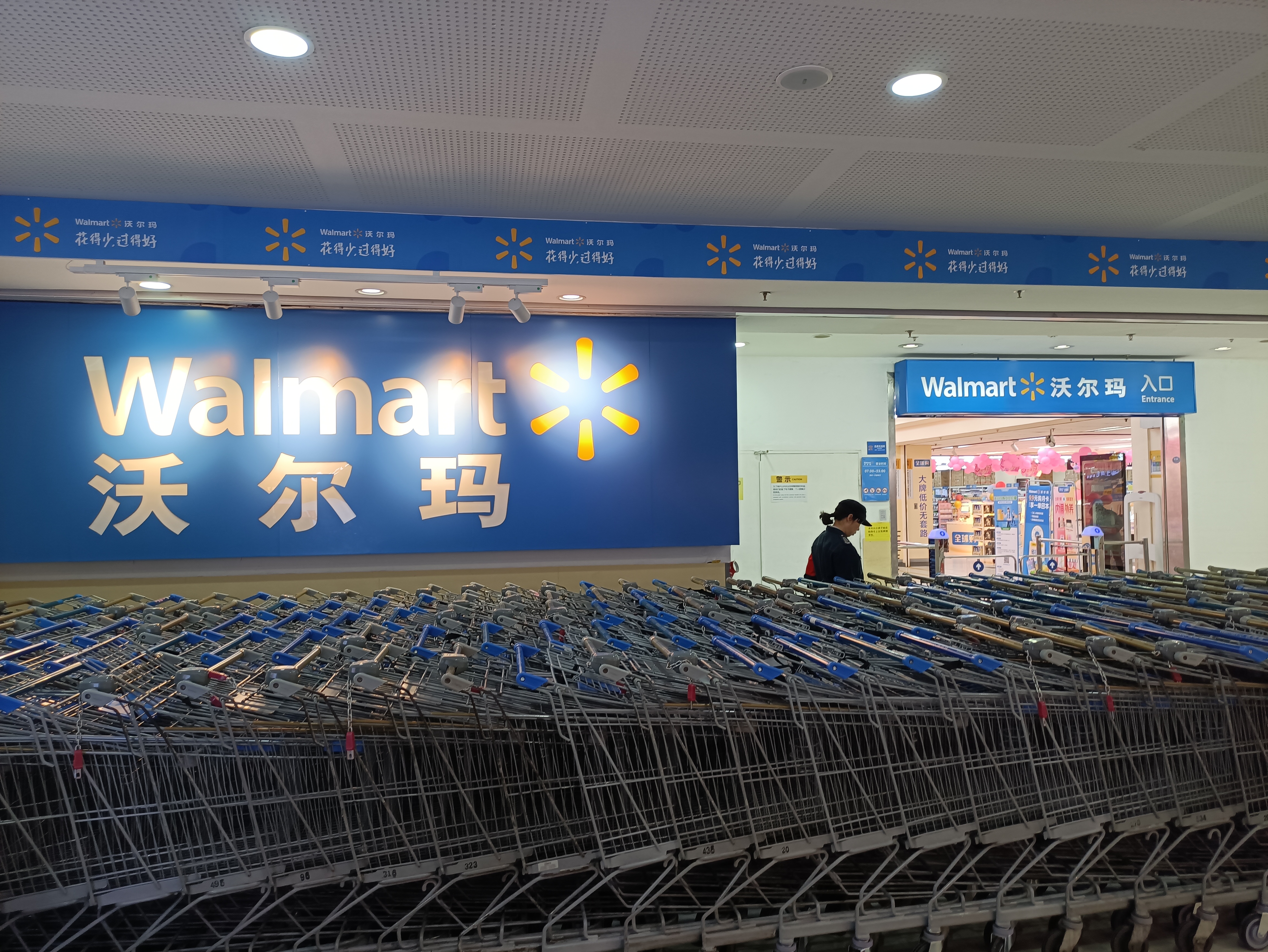
Walmart entered China in 1996 and at peak operated about 400 Walmart-brand hypermarkets. Starting in 2016, hypermarkets began a structural contraction — by 2025, only around 283 remain, meaning roughly 129 stores closed over five years (9 / 42 / 39 / 26 in 2020-2023, plus more in 2024-25 including locations in Nanjing and Hangzhou).
The reason isn’t complicated: traditional hypermarkets are being squeezed from three directions — community group-buy, instant retail, and warehouse clubs. Walmart’s answer is to run three lines in the same market:
- Hypermarkets: shrinking and upgrading (compact formats, digital retrofit)
- Sam’s Club: aggressive expansion (detailed next section)
- Neighborhood Stores: a new format — roughly 500 m², 2,000 SKUs, positioned in a “10-minute walking radius.” Piloted in Shenzhen in 2024; the fourth opened in Baoan in September 2025 and the format is now scaling.
Walmart China CEO Joey Zhu has publicly said 500 new stores over the next 5-7 years — across hypermarkets, Sam’s, neighborhood stores, and cloud warehouses, with neighborhood stores being a primary direction.
Financially, FY26 Q3 (Aug-Oct 2025) China net sales were **24B / ~170 billion RMB. Q3 e-commerce grew 32% and exceeded 50% of total sales. In a decade when foreign retail has broadly retreated from China, Walmart China is one of the rare foreign retailers still growing — and the engine is Sam’s Club.
III. Sam’s Club: The Real Engine of Walmart China
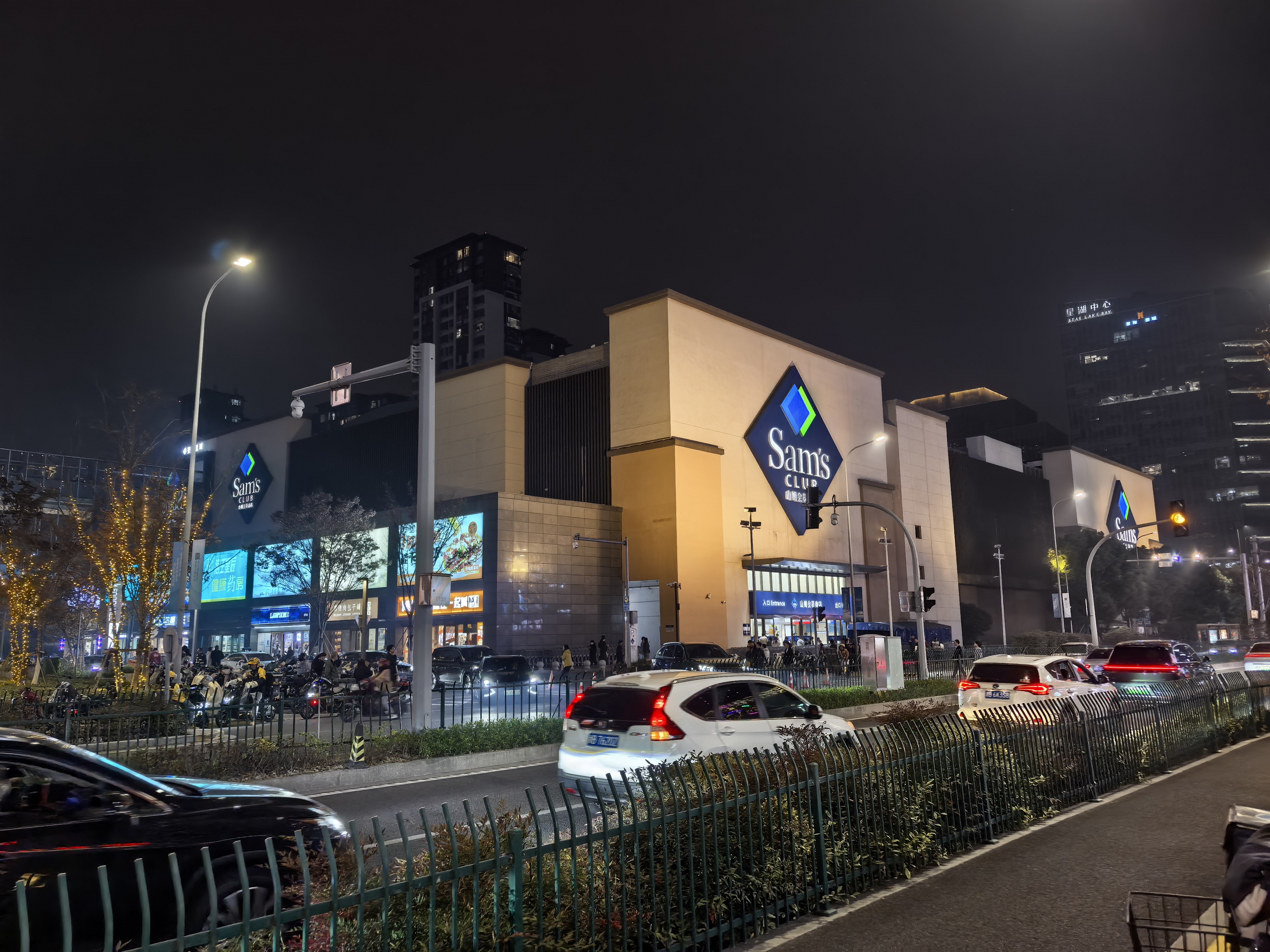
Sam’s Club is worth looking at as a standalone business, because it drives the numbers for all of Walmart China.
Key 2025 data points:
- Stores: 61-63 by year-end. The latest is the November 21 opening in Beijing’s Changping district — Beijing’s fifth and the 61st nationwide. Ten new stores opened in 2025 — a record for the company.
- Sales: over 140 billion RMB, up about 40%. Accounts for roughly two-thirds of Walmart China’s total.
- Per-store efficiency: at least 8 stores broke 3.6 billion RMB in annual sales; the average tops 2.2 billion RMB — 25× Yonghui’s per-store number.
- Paid members: roughly 10.7 million (260 RMB standard / 680 RMB Excellence).
- Membership revenue: about 2.2 billion RMB per year (dual-revenue model: goods margin + membership fees, the latter nearly pure profit).
- E-commerce: high share — app pre-ordering plus cloud-warehouse delivery.
Core business model: paid entry + curated large packs + global direct sourcing + Member’s Mark private label + low margin, high turnover. Functionally identical to the Costco model, with local adjustments — bakery, deli, and fresh seafood weight is higher than in U.S. Sam’s.
The cracks are showing. 2024-25 social-media and media discussion repeatedly surfaced accusations of “Sam’s quality decline,” “SKUs going mass-market,” “trust crisis.” The core tension: paid members expect curation far more strictly than ordinary supermarket shoppers; if SKU localization and store rollout outpace curation capability, member trust erodes. Momentum Works literally ran a piece titled “Sam’s Club’s good days in China might be numbered.”
But on absolute numbers, Sam’s Club is still the Chinese supermarket industry’s highest per-store efficiency, fastest growing, and most profitable operator by a wide margin. Costco has only opened 7 stores in China by 2025 — not in the same league.
IV. Hema: Profitability After Ten Years
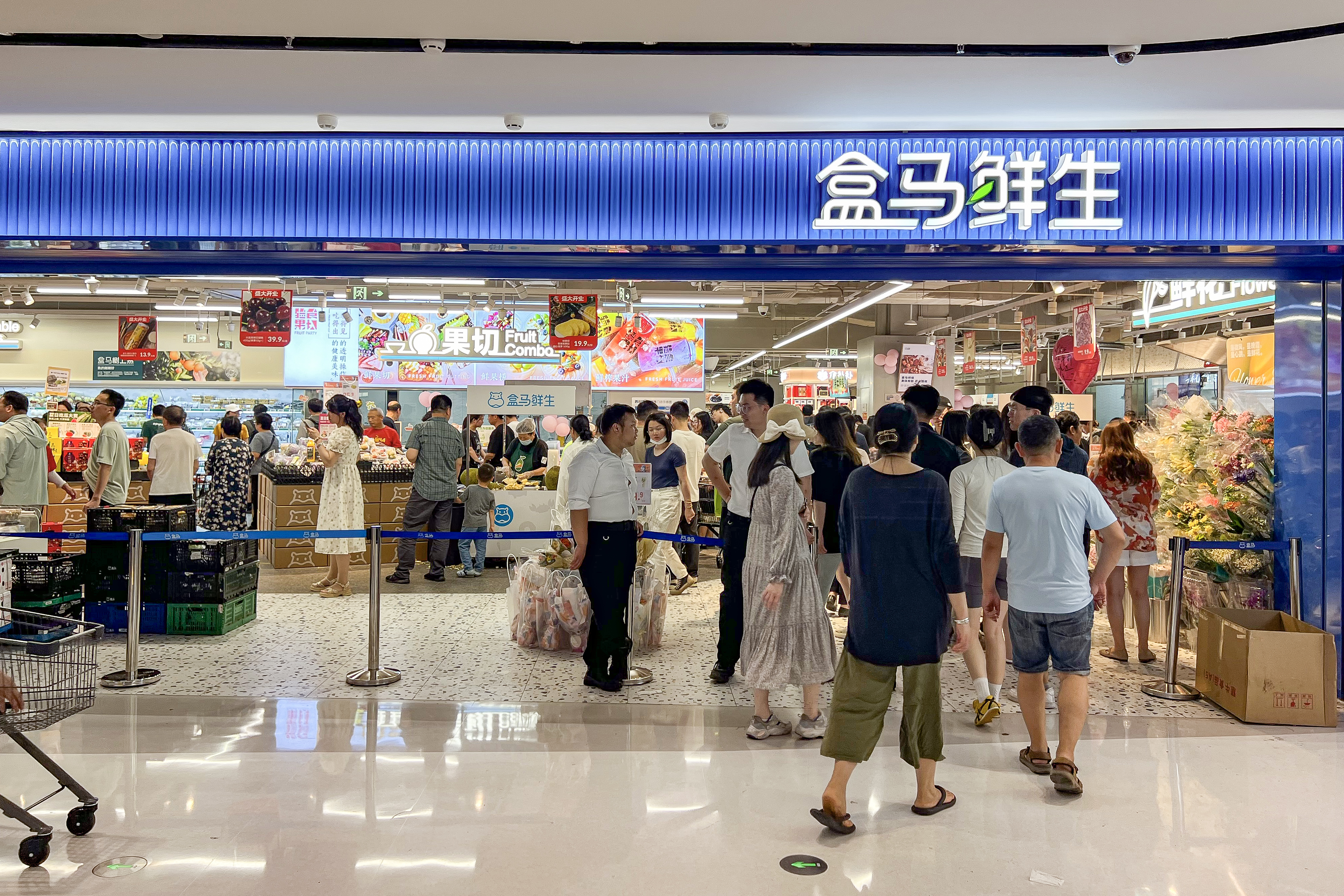
Hema was Alibaba’s “new retail flagship” from late 2015, opening its first store at Shanghai Jinqiao in early 2016. Ten years later (FY25, April 2024 – March 2025), it delivered its first full year of overall profitability:
- GMV: ~75 billion RMB (FY25) — still short of founder Hou Yi’s “100 billion in three years” goal
- Adjusted EBITA: positive for the full year for the first time (exact figure undisclosed)
- Stores: 420+ Hema Fresh (72-100 new in FY25), covering 50+ cities; plus the discount format Hehesuan NB, now 400-500 stores
- Private label share: Hema Fresh close to 50%, NB above 60%
- Global supply chain share: ~35%, contributing 60% of sales — the sharpest single differentiator from ordinary supermarkets
Format evolution: over ten years Hema piloted 10 different formats — Hema Fresh, Hema F2, Hema mini, Hema Xiaozhan, Hema Neighborhood, Hema X Club, Hema NB, Hehesuan NB, Hema Outlet, and others. 2025 saw a clear strategic convergence:
- Closed the X Club (gave up going head-to-head with Sam’s)
- Focused on Hema Fresh + Hehesuan NB — premium + value covering both ends
- Restarted forward warehouses as “satellite warehouses” orbiting the big stores in a “1 store + N warehouses” stereo ecosystem
The judgment behind this: Hema can’t beat Sam’s at membership club, but has room to go downmarket. Former COO (now CEO) Yan Xiaolei explicitly said in early 2025: “no longer chasing Sam’s — chasing Pang Donglai” (i.e., competing on price-to-value and supply chain depth rather than membership exclusivity).
Ownership: Hema remains wholly owned by Alibaba. The IPO plan started in May 2023 was postponed in November 2023 (reportedly because the valuation didn’t meet expectations). In February 2025, Alibaba’s CFO stated “we have no current plans to sell Hema” and positioned it as “Alibaba’s new-retail flagship and the success story of integrating online and offline.”
Per-store efficiency: Hema Fresh averages about 196 million RMB per store per year. Higher than Yonghui but an order of magnitude below Sam’s.
V. Yonghui: From “Domestic Fresh Champion” to “Pang Donglai Apprentice”
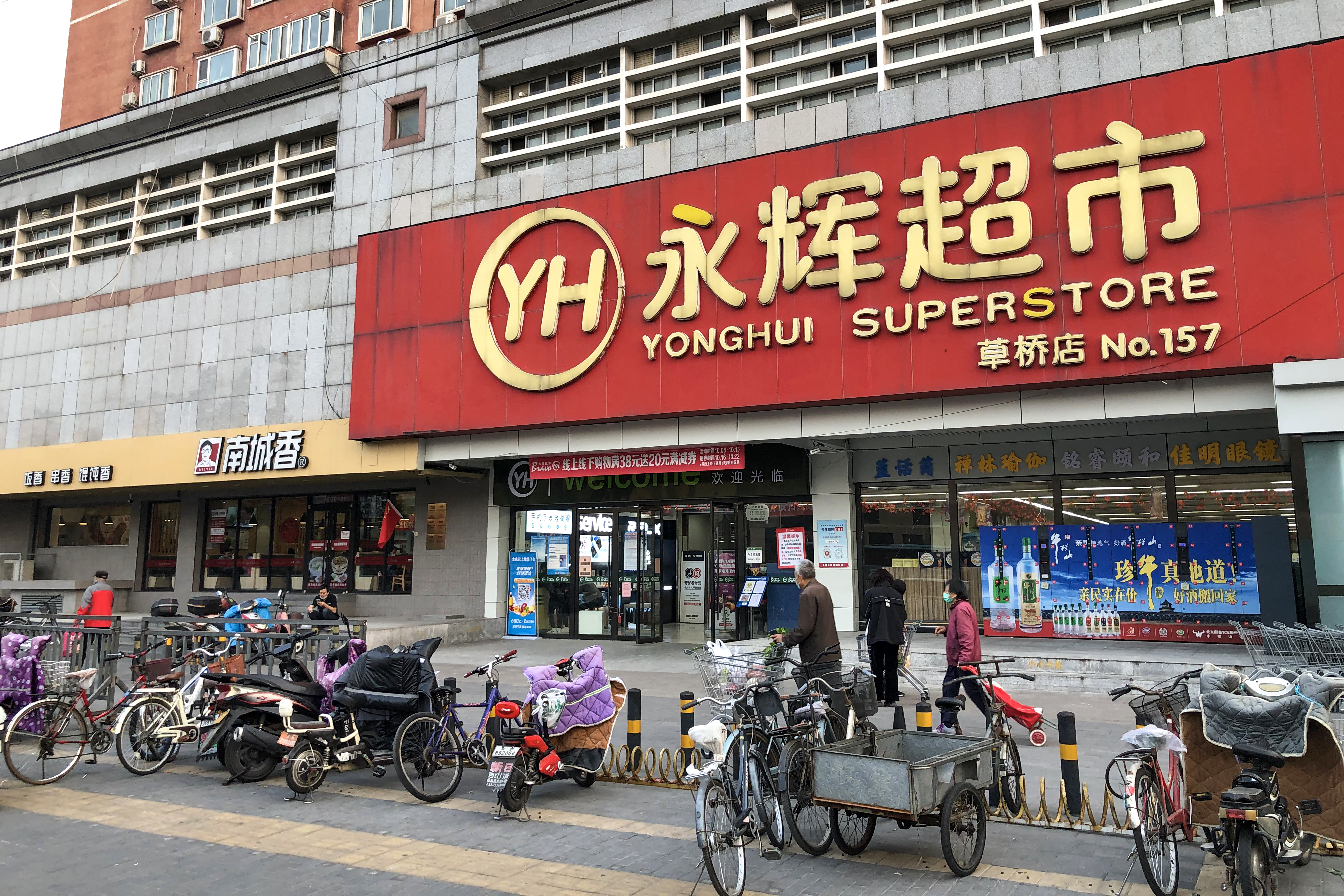
Yonghui is the only domestic traditional supermarket leader in this comparison. Founded in Fuzhou in 2001 and listed on the A-share market in 2010, it peaked in 2020 at 93.2 billion RMB in revenue and over 1,000 stores. Decline followed:
| Year | Revenue (B RMB) | YoY | Net profit attributable to shareholders | Note |
|---|---|---|---|---|
| 2020 | 93.2 | — | +1.794 billion | Peak |
| 2021 | — | — | -3.944 billion | Losses begin |
| 2022 | — | — | -2.763 billion | |
| 2023 | 78.64 | -15% | -1.329 billion | |
| 2024 | 67.57 | -14.07% | -1.465 billion | 4-year cumulative loss ~9.5 billion |
| 2025H1 (guidance) | — | — | -240 million | Losses significantly narrowed |
Nine-plus billion yuan lost over four years, yet the company is still alive. In September 2024, Miniso founder Ye Guofu spent 6.27 billion RMB to acquire 29.4% of Yonghui — becoming the largest shareholder and taking over as acting CEO. The JD.com-linked camp exited the top shareholder position. The strategic structure changed overnight.
Ye Guofu’s playbook is blunt: learn from Pang Donglai. The Henan-based Pang Donglai is famous for “extreme quality + extreme employee treatment + extreme SKU curation,” with per-store annual sales of 1.307 billion RMB — 15× Yonghui’s number. Starting in June 2024, Yonghui voluntarily began renovating stores along Pang Donglai lines. 2025 became the main renovation year:
Pang Donglai-model renovation (through Q3 2025):
- Renovated stores: 222 by end of Q3; later exceeded 315
- Closed stores: 381 in 2025 — surgical “amputation”
- Employee compensation: average pay up 20% post-renovation, some stores up 80%; cumulative profit-sharing January-August 2025 over 31 million RMB
- SKU restructure: a typical store dropped 4,744 SKUs and added 5,425 (a 47% new-SKU ratio), reaching ~80% similarity to Pang Donglai’s assortment
Interim results:
- Renovated stores: traffic up 80% on average
- 19 stores: NPS (Net Promoter Score) above 50%
- 60%+ of renovated stores that reached the stable phase surpassed their best profit in the past 5 years
- Beijing Jiugong store: average ticket up from 98 RMB to 125 RMB; fresh food loss rate 12% → 7%; gross margin +3 percentage points
- Tianjin SM Binhai Plaza store (opened January 2025): monthly profit-sharing ~300,000 RMB, cumulative sales above 350 million RMB
- 2025 Golden Week / Mid-Autumn combined holiday: renovated stores saw sales more than double year-on-year
This is the single most-watched retail renovation story in China for 2024-25. Skeptics note the marginal problem: Pang Donglai’s quality and staff treatment is the product of 30 years of small-scale, deep-focus operation. Whether it can be replicated across 800+ stores nationwide is a structural question. Ye Guofu has defined 2025 as the “loss-reduction year” with the keyword “three raises, two cuts” — raise productivity, raise revenue, raise gross margin; cut costs, cut expenses.
VI. Business Models Compared
All four “sell groceries,” but the underlying models differ sharply:
Walmart China hypermarkets (+ neighborhood):
- Traditional hypermarket “one-stop shopping + scale purchasing + low margin”
- Profit driven by scale; structurally losing to instant retail and membership clubs
- Neighborhood stores are an attempt to hedge against community group-buy and convenience stores
Sam’s Club:
- Dual-revenue model: goods margin + paid annual membership fee
- Paid entry filter + curated SKU + global direct sourcing + large packaging
- Goods gross margin far below ordinary supermarkets (10-14%), with membership fee filling profit
- Economically closest to Costco — “membership fee is the real profit source”
Hema:
- Store-warehouse integration (50%+ online share at the large-store level) + private label + global supply chain
- Core mechanism: eat instant retail with “30-minute delivery within 3 km” + eat middlemen with private label
- Hardest part: rent + labor offline plus fulfillment cost online, stacked
- Ten years later, the model is finally proven to be runnable (EBITA positive ≠ net income positive)
Yonghui + Pang Donglai model:
- Traditional supermarket model + extreme SKU curation (reducing SKU count) + high-pay employees driving service quality
- No membership, no store-warehouse integration — back to retail basics: products and service done to an extreme
- Economically a bet that the rising gross margin and traffic will cover the rising labor cost — execution depends on the relative speed of margin lift vs labor cost lift
Summary: four paradigms for Chinese retail — traditional hypermarket (Walmart), paid membership (Sam’s), new retail (Hema), quality supermarket (Yonghui / Pang Donglai). 2025’s factual verdict: Sam’s is surging, Hema just broke even, Yonghui is fighting, traditional hypermarkets are shrinking.
VII. Operating Efficiency
Per-store annual sales (2024 data):
| Company | Per-store sales | Ratio to Sam’s |
|---|---|---|
| Sam’s Club | >2.2 billion RMB average; top stores 3.6 billion | 100% |
| Pang Donglai | 1.307 billion RMB | 59% |
| Hema Fresh | 196 million RMB | 9% |
| Walmart hypermarket | ~100 million RMB | ~4.5% |
| Yonghui | 85 million RMB | ~4% |
| Wumart | 55 million RMB | ~2.5% |
Sam’s per-store sales is 25× Yonghui’s. Two different species.
Gross margin + private label (2025 public data):
- Sam’s: Member’s Mark private label ~30%+, structurally high-margin
- Hema: Hema Fresh near 50%, Hehesuan NB over 60%
- Yonghui: aggressive private-label expansion in renovated stores, but share not separately disclosed
- Walmart hypermarket: low private-label share (traditional hypermarket pattern)
E-commerce share (2025):
- Walmart China: >50% (Sam’s + hypermarket combined)
- Hema: native online + store-warehouse integration, long-term high share
- Sam’s: app booking + cloud-warehouse delivery, high share
- Yonghui: low (traditional hypermarket)
Labor productivity — public data is incomplete, but the gaps are visible:
- Sam’s: extremely high (large format + lean staffing + high ticket + membership)
- Pang Donglai: high pay for small elite — likely the highest in the industry
- Yonghui (post-renovation): pay raised sharply, but closing the productivity gap with Pang Donglai is a multi-year task
- Hema: store + picking + delivery means three layers of headcount; labor cost is a structural challenge
VIII. Management Styles
Four companies, four distinctly different decision structures:
Walmart China / Sam’s:
- Standard foreign multinational structure; CEO Joey Zhu reports to Walmart global
- Sam’s enjoys relative management autonomy and resource tilt inside China
- Walmart DNA: standardization, global supply chain, data-driven
- Organizationally stable; transformation is “multi-year planned”
Hema:
- “Quasi-independent company” inside the Alibaba ecosystem
- CEO changed in March 2024: Hou Yi out, Yan Xiaolei in
- In the 2024-25 Alibaba restructure, Hema was folded into the “Big Taobao” consumer platform — independent IPO is off
- Management culture is internet-style: rapid experimentation followed by convergence
- 10 formats in 10 years is the signature output of that style
Yonghui:
- A-share listed + new largest shareholder (Miniso, 29.4%)
- Founder Zhang Xuansong still holds ~14% and has strategic disagreements with Ye Guofu (voted against the mass store-closure plan)
- Ye Guofu brings Miniso’s “hit-product thinking + strong SKU discipline + employee incentives” into Yonghui
- But Yonghui’s scale (800+ stores / 50,000+ employees) is much larger than Miniso — whether “apprentice-style management” works at this scale is an open question
- Miniso has taken an 800M RMB accounting hit on the Yonghui stake in one year
Sam’s (standalone):
- CEO Joey Zhu concurrently runs Sam’s China, but Sam’s has a direct reporting line into global Sam’s for systems
- This hybrid preserves both local resource access (via Walmart China) and global standards (via Sam’s HQ)
- One of the rare examples of a foreign company successfully preserving global standards in China
IX. 2026 Outlook
2026 opening plans announced (per January 2026 Linkshop compilation):
- Sam’s: continued expansion, targeting ~10 new stores
- Hema: 100 new Hema Fresh stores covering 50+ new cities
- Walmart China: continued neighborhood-store scaling + Sam’s expansion; hypermarkets continue optimization
- Yonghui: complete renovation or closure of all stores by end of 2026 — Ye Guofu’s self-imposed deadline
The three things to watch in 2026:
- Can Sam’s sustain high growth? At 60+ stores, can it still do +40%? Will the “trust crisis” narrative turn into actual member churn?
- Can Hema move from EBITA-positive to net-income-positive? Ten years validated the model. The next step is to validate scalable, sustained profitability.
- Can Yonghui’s Pang Donglai-ization actually work? 315 renovated stores: success model or edge cases? Replicating Pang Donglai quality across 800+ stores is the hardest organizational problem.
Zooming out: 80%+ of Chinese supermarkets did renovations in 2025, and 90%+ of those saw sales lifts — “learning from Pang Donglai” has moved from a single-company story to an industry-wide movement. The question in China’s supermarket sector in 2025 isn’t “who survives” — it’s “who can replicate the essence of extreme retail.”
X. Conclusion
The Chinese supermarket landscape in 2025:
- Most profitable: Sam’s Club (Walmart China’s profit core + 2.2 billion RMB in membership fees)
- Most adaptive: Hema (10 formats in 10 years, finally profitable)
- Most embattled: Yonghui (9.5 billion RMB in cumulative losses, but Pang Donglai-model renovation offers hope)
- Most balanced: Walmart China overall (hypermarket retreat + Sam’s advance + neighborhood expansion, three tracks in parallel)
The larger observation: the Chinese supermarket market has run out the clock on “scale eats scale.” Leaders now win by paid-member gating + SKU curation (Sam’s), or by digitalization + private label (Hema), or by employee incentives + extreme curation (Pang Donglai / Yonghui apprentice).
The common thread: from “sell more stuff” to “sell better stuff.” China retail is shifting from scale-driven to quality-driven — and 2025 is the first clear inflection in that shift.
References
Walmart China / Sam’s Club:
- Walmart Inc 2025 Annual Report — Global 10-K
- Walmart FY26 Q3 Earnings Release — China Q3 data
- China Daily: Walmart’s business in China outperforming global average sales — China revenue growth
- 36kr: Why Is Walmart China Leading with a 21.8% Revenue Surge — Business breakdown
- China Daily: Walmart pivots to neighborhood stores as hypermarkets fade — Neighborhood store strategy
- Guancha.cn: The two faces of Walmart China — Sam’s surges, supermarket pivots — Format analysis
- Sina Finance: 147.3 billion RMB – “China’s supermarket No.1” reports results — Revenue data
- Walmart China corporate site — Format and store information
- Statista: Sam’s Club in China - statistics & facts — Aggregate data
- CNBC: Why Sam’s Club is in a sweet spot as China faces consumption worries — Macro perspective
- Momentum Works: Sam’s Club’s good days in China might be numbered — Challenge analysis
- Double V Consulting: Sam’s Club’s Trust Crisis in China — Trust issue
Hema / Freshippo:
- 36kr: Not selling Hema, bringing in strategic investors — Hema as Alibaba’s “last line of new retail” — Strategic positioning
- STCN: Hema 2025 revenue growth over 40%, GMV to exceed 100 billion — GMV outlook
- Shanghai Observer: Hema to open 100 new stores this fiscal year, total to exceed 500 — Expansion plan
- Sina Finance: Closing the X Club — behind Hema’s “strategic amputation” — X Club closure
- Leiphone: Hema arrives at an inflection point — Strategic analysis
- STCN: Hema NB’s pivotal shift — “Chaohesuan NB” arrives — NB strategy
- Tianfeng Finance: Hema’s ten-year pivot — 10-year retrospective
Yonghui:
- Yonghui A-share filings (SSE 601933) — Official filings
- Tencent News: Ye Guofu reshuffles Yonghui, JD exits — Ownership restructuring
- STCN: Miniso board members enter Yonghui, 6.27 billion RMB acquisition completes — Acquisition details
- Sina Finance: Yonghui transformation pain deepens, H1 2025 expected loss of 240 million — 2025H1 guidance
- Winshang: Yonghui’s four-year cumulative loss of 9.5 billion — Long-term loss record
- 36kr: Yonghui’s renovation path — can “Pang Donglai model” reshape a national quality supermarket? — Renovation effects
- STCN: Yonghui 9M 2025 revenue 42.4 billion, 222 stores completed Pang Donglai-model renovation — Q3 data
- Beijing Daily: Average traffic up 80% — Yonghui renovation data — Renovation KPIs
- Guancha.cn: Yonghui may close 350 stores — Closure plan
- NetEase: One year after taking over Yonghui, Miniso has taken an 800M RMB hit — Miniso’s cost
Industry-wide:
- Linkshop / Sina Tech: 2026 opening plans from Sam’s, Aldi, Hema and others — 2026 opening summary
- CBNData: Traditional supermarkets close while warehouse clubs surge — Industry trend
- 21 Jingji: Supermarket sector exits ice-and-fire 2025, what to watch in 2026 — Industry overview
- 36kr: Sam’s, Pang Donglai, Aldi, Hema — private label takes center stage — Private label trend
- 36kr: Only Sam’s still runs on paid membership clubs, Costco silent — Membership landscape
- 36kr: Pang Donglai “up,” Hema “down” — the road away from Sam’s diverges — Strategic divergence
- Jiemian: The other side of 2025 China supermarket — Hema in the Pang Donglai-renovation shadow — Pang Donglai spillover
- CCFA 2024 Top 100 Retailer list — Industry ranking